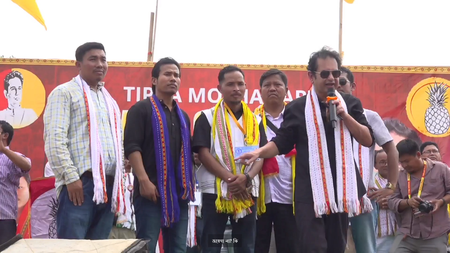
Agartala, April 17: The Tipra Motha Party (TMP) has secured a decisive victory in the elections to the Tripura Tribal Areas Autonomous District Council (TTAADC), retaining control of the politically significant body and reinforcing its growing influence in the state’s political landscape.
The 30-member council, comprising 28 elected representatives and two members nominated by the state government, administers nearly 70 per cent of Tripura’s geographical area. In the latest polls, the tribal-based TMP, led by former royal scion Pradyot Bikram Manikya Debbarma, won 24 seats—an increase of six seats from the previous election.
Senior TMP leaders Jagadhish Debbarma, the outgoing Chairman and Chief Executive Member (CEM), and Purna Chandra Jamatia were re-elected, further consolidating the party’s leadership within the council. Political observers noted that this marks TMP’s second consecutive victory in the TTAADC, underscoring its firm hold over tribal politics in the state.
The Bharatiya Janata Party (BJP), despite being an ally of TMP, witnessed a significant decline, securing only four seats compared to 10 in the 2021 elections. Meanwhile, the CPI(M)-led Left Front and the Congress once again failed to win any seats, mirroring their performance in the previous council polls.
The elections, held on April 12, saw a high voter turnout of over 83.5 per cent among the 9.62 lakh eligible voters. A total of 173 candidates, including eight women, contested the polls across 28 constituencies. The BJP, TMP, and the Left Front fielded candidates in all seats, while the Congress contested 27 and the Indigenous People’s Front of Tripura (IPFT) 24.
Counting of votes took place on Friday under strict three-tier security arrangements across 17 centres in all eight districts. Authorities imposed prohibitory orders around counting venues to maintain law and order.
Established in 1985 under the Sixth Schedule of the Constitution, the TTAADC plays a crucial role in the socio-economic development of tribal communities, who constitute nearly one-third of Tripura’s population. Despite its limited powers, it remains the state’s second most important constitutional body after the Assembly.