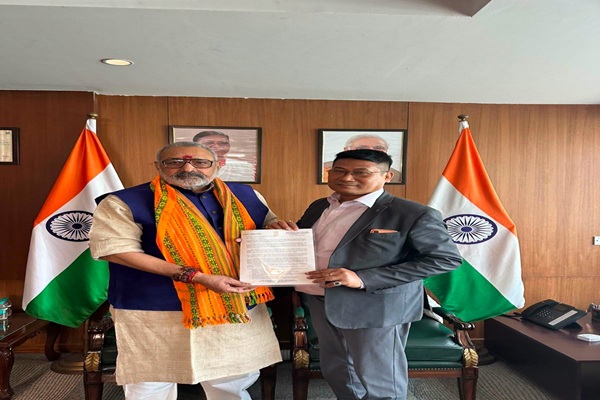
Agartala, July 13: Tripura Tribal Welfare Minister Bikash Debbarma on Monday met Union Textiles Minister Giriraj Singh in New Delhi and sought the Centre’s support for a series of ambitious projects aimed at strengthening the state’s textile, handloom, handicrafts and silk sectors.
The meeting focused on formulating a long-term roadmap for the development of Tripura’s textile ecosystem while promoting the state’s rich handloom heritage, bamboo and cane handicrafts, silk industry and traditional tribal crafts. Debbarma highlighted the immense potential of these sectors in generating employment, preserving indigenous skills and contributing to the state’s economic growth.
During the meeting, the minister submitted a comprehensive set of proposals to the Union government. Among the key demands were the establishment of an Integrated Textile Park and a Silk Park to strengthen production, processing and marketing infrastructure. He also sought the setting up of a National Institute of Design (NID), an Indian Institute of Handloom Technology (IIHT) and a Central Silk Reeling School (CSRS) in Tripura to enhance technical education, research and skill development in the textile and sericulture sectors.
In addition, Debbarma proposed promoting industries based on locally available raw materials such as bamboo, pineapple fibre and banana fibre. He also urged the Centre to support the development of a dedicated craft village, establishment of a handicrafts museum, expansion of export infrastructure and strengthening of institutional capacity to improve market access for local artisans and entrepreneurs.
The discussions also centred on Tripura’s potential role in advancing flagship national initiatives, including “Viksit Bharat @2047,” “Vocal for Local,” and “Make in India.” The minister emphasised that the state’s traditional handloom and handicraft products possess significant potential for domestic as well as international markets and could contribute meaningfully to India’s growing textile exports.
Debbarma expressed optimism that the Centre’s support for the proposed projects would open new avenues of livelihood for weavers, artisans, sericulture farmers, women’s self-help groups and aspiring young entrepreneurs across Tripura. He said improved infrastructure, modern training facilities and enhanced market connectivity would help preserve the state’s traditional crafts while making them globally competitive.
Reaffirming the state government’s commitment to the sector, Debbarma said Tripura would continue to work closely with the Central government to promote its rich textile and handicraft heritage, generate sustainable employment and position the state as an emerging hub for handloom, handicrafts and silk production in the Northeast.