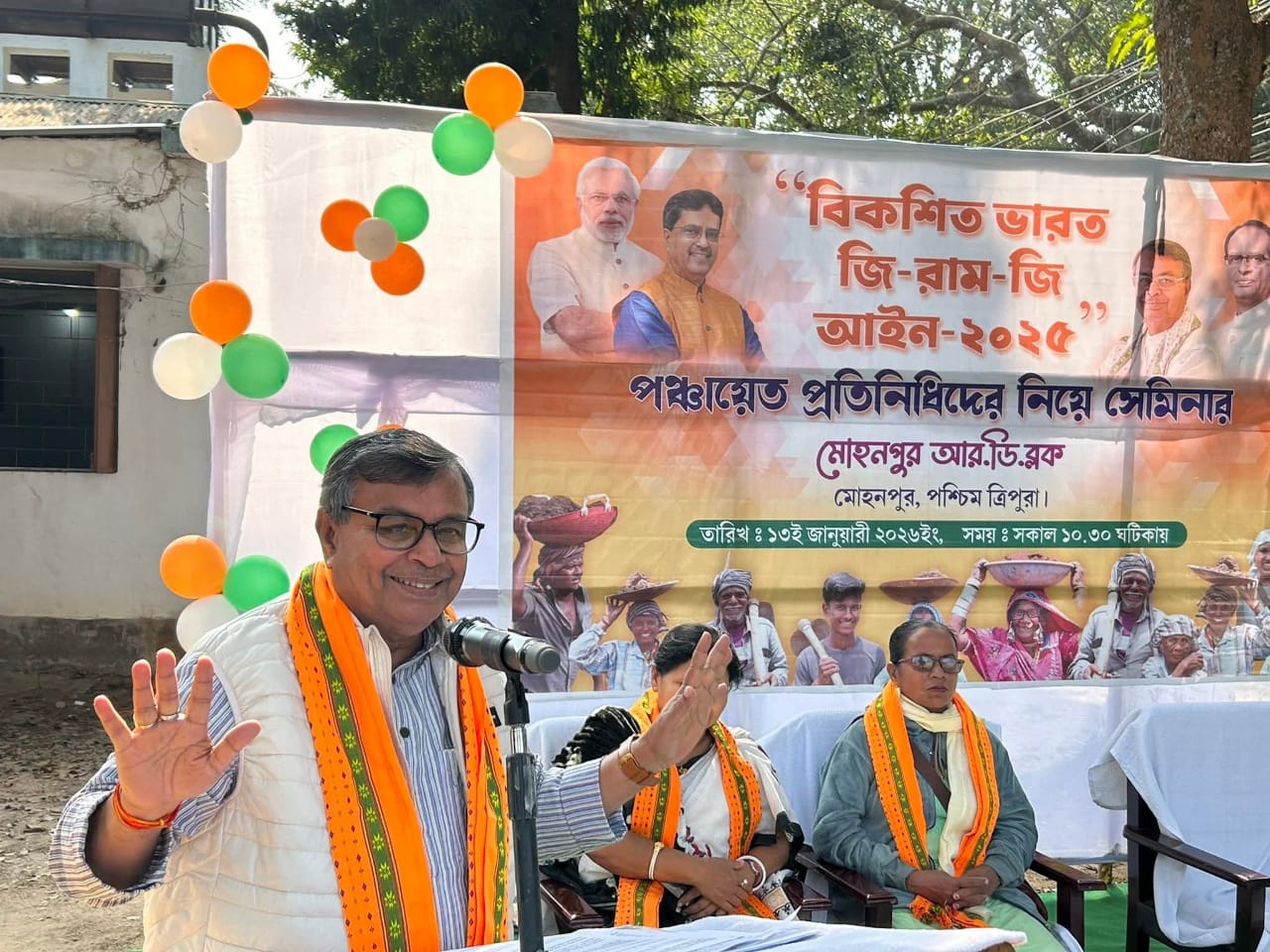
Agartala: Agriculture and Farmers’ Welfare Minister Ratan Lal Nath on Tuesday said that the newly introduced VB-GRAMG Act is not merely an administrative reform but a people-centric initiative aimed at expanding welfare opportunities and strengthening rural development. He was speaking at an important discussion meeting held at the Mohanpur Block premises.
The meeting witnessed participation from public representatives of all panchayats under the block, workers previously associated with MGNREGA, officials from various line departments, and Block Development Officers. An in-depth discussion was held on the objectives, implementation, and benefits of the VB-GRAMG Act.
Addressing the gathering, the Minister emphasized that the success of the new Act depends on public trust, participation, and proper awareness. “This law has been framed for the welfare of the people, and its real path lies with the people themselves,” he said, stressing the need for wide publicity and dissemination.
Highlighting the Union government’s commitment to rural development, Nath said that since 2014, Prime Minister Narendra Modi has consistently prioritized villages, farmers, and the poor. He pointed out that while MGNREGA existed even before 2014, budgetary allocations were significantly lower. “From 2004 to 2014, the total MNREGA allocation was around Rs 2.13 lakh crore. Between 2015 and 2025, it increased to Rs 7.80 lakh crore,” he said. The highest annual allocation earlier was Rs 33,000 crore, which later rose to Rs 86,000 crore during the Modi government’s tenure.
The Minister stated that asset creation remains the core objective of MNREGA. Over the last seven years, Tripura has created more than 8.10 lakh assets, compared to 6.67 lakh assets in the seven years prior to 2018. Wage payments have also increased, with Rs 5,332 crore disbursed in the past seven years.
Nath alleged that large-scale corruption had taken place under the previous Left Front regime. He said VB-GRAMG ensures transparency through direct transfer of wages to workers’ bank accounts. The Act also focuses on water conservation, livelihood generation, rural infrastructure, and climate change mitigation, marking a new chapter in rural welfare.