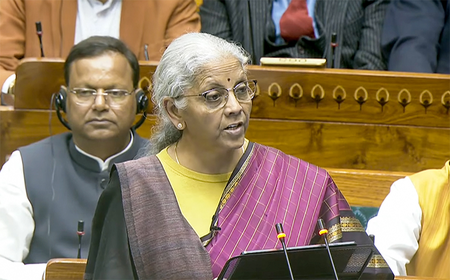
New Delhi, Feb 1: Finance Minister Nirmala Sitharaman on Sunday announced a capital expenditure outlay of ₹12.2 lakh crore in the Union Budget for 2026-27, underlining the government’s continued focus on infrastructure-led growth and job creation.
Presenting the Budget, Sitharaman said a new Infrastructure Risk Development Fund will be set up to accelerate the execution of large-scale projects by addressing funding and risk-related challenges. The move is aimed at crowding in private investment and ensuring timely completion of big-ticket infrastructure ventures.
The Finance Minister said the Budget delivers a strong push to core infrastructure such as highways, ports, railways and power, while also focusing on scaling up manufacturing in seven strategic and frontier sectors. In addition, the government aims to create “champion MSMEs” to strengthen domestic supply chains and boost employment generation.
Emphasising fiscal discipline, Sitharaman said the government has maintained fiscal prudence and monetary stability, even as it continues to prioritise public investment as a key driver of economic growth. She stressed that India must remain deeply integrated with global markets by expanding exports and attracting foreign investment to meet its growing trade and capital requirements.
Highlighting reform efforts, the Finance Minister said the government has rolled out more than 350 reforms to boost productivity, create employment and accelerate economic growth. “The Reforms Express is well on its way, and India will continue to take confident steps towards Viksit Bharat, balancing ambition with inclusion,” she said.
Sitharaman noted that the Budget, prepared at Kartavya Bhavan, is anchored around three “kartavyas” or duties: accelerating and sustaining economic growth, fulfilling the aspirations of citizens by building capacity, and ensuring equitable access to resources for every family, community and region.
She added that sustaining the momentum of structural reforms remains critical and called for continuous, adaptive and forward-looking policymaking. Cutting-edge technologies, including artificial intelligence, were highlighted as potential growth multipliers for the economy.