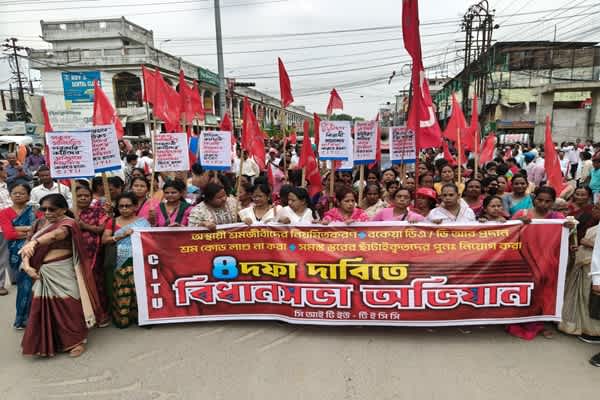
Agartala, March 23: The Centre of Indian Trade Unions on Monday organised a massive Assembly march in the state capital, pressing a four-point charter of demands and drawing a large turnout of workers and supporters. The rally began from Orient Chowmuhani and was led by prominent Left leaders, including former Chief Minister Manik Sarkar, Sankar Prasad Dutta, and Manik Dey.
However, the march was halted by police at Dimsagar, preventing protesters from advancing towards the Assembly. Following the blockade, demonstrators held a public meeting at the site, where several opposition leaders addressed the gathering.
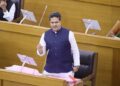
Leader of the Opposition Jitendra Chaudhury joined the protest and, along with Sarkar, launched sharp criticism against the state government. They accused the administration of failing to safeguard workers’ rights and of suppressing dissenting voices within the Assembly.
Addressing the crowd, Manik Sarkar alleged that the “double-engine government” has failed to deliver on promises made during the 2018 elections. He claimed that similar assurances are now being repackaged for other states, terming it a “politics of deception.” Sarkar also alleged that opposition members are frequently silenced in the Assembly, with microphones being switched off during debates.
In a strong attack, Sarkar criticised the role of the police, describing them as acting under political influence. He cited an alleged incident involving Pabitra Kar, state secretary of the All India Kisan Sabha, who was reportedly assaulted during a protest. Sarkar termed the administration “anti-people” and accused it of being hostile to the working class.
Jitendra Chaudhury, in his address, contrasted the current situation with the Left Front era, claiming that irregular employees were earlier regularised after ten years of service and granted benefits similar to permanent staff. He alleged that since 2018, thousands of such workers have been retrenched, while existing employees have faced stagnation in wages and benefits.
The large turnout reflected growing concerns over employment security and labour rights. CITU leaders asserted that the movement would continue, framing the march as part of a broader struggle for workers’ rights and democratic space in Tripura.