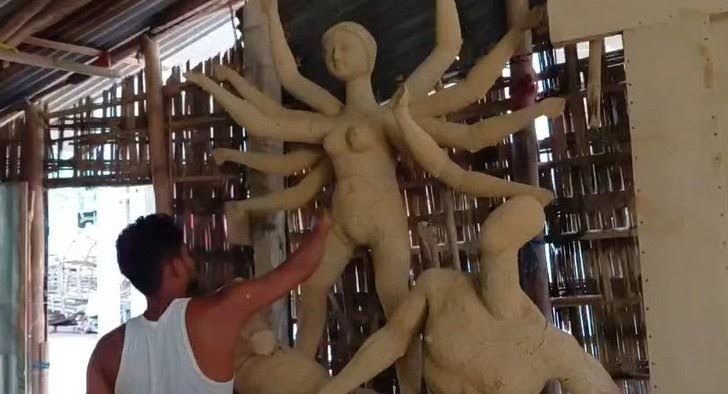
Agartala, September 26: As Durga Puja draws closer, idol-making activity has intensified in Kalyanpur and other parts of Tripura. Behind the colourful preparations, however, traditional clay artisans are confronting a difficult reality — rising production costs, a shortage of skilled workers and uncertain demand are steadily squeezing their livelihoods.
For Kalyanpur-based artisan Bhuban Rudrapal, clay idol-making has been a profession for nearly two decades. What started as an alternative livelihood after he struggled to support his family through fish vending eventually became his full-time occupation.
A resident of Kalyanpur Bazar Colony, Rudrapal recalled that he once travelled through tribal-dominated areas selling fish. Finding the income inadequate, he began learning idol-making from his brother-in-law while continuing his fish business.
“I learned the craft of making idols from clay from my brother-in-law while continuing to sell fish. Later, I left fish vending and took up idol-making full-time. I would make idols at home according to my own designs,” he said.
Over the years, Rudrapal established a reputation among customers in and around Kalyanpur. He has crafted idols of several deities, including Manasa, Kali, Vishwakarma, Loknath, Bipadnashini, Durga and Lakshmi. His home workshop once received a steady flow of orders from neighbouring areas.
But the economics of traditional idol-making have changed significantly.
The cost of clay, straw, bamboo and paints has increased, while labour charges have risen as well. At the same time, artisans are finding it increasingly difficult to locate workers with the skills required for traditional idol-making.
“Compared to earlier, the cost of raw materials has increased significantly. Labour expenses have also gone up. The biggest problem is that it has become difficult to find skilled workers. After meeting all the expenses, there is very little profit left from making an idol,” Rudrapal said.
The COVID-19 pandemic added another setback. Restrictions on Puja celebrations led to a sharp fall in demand for idols, leaving artisans struggling with fewer orders at a time when production expenses remained a burden.
Rudrapal believes sustained government intervention is needed to protect the traditional pottery and idol-making sector. According to him, many families depend directly or indirectly on the craft, but artisans continue to face challenges in securing raw materials, accessing financial support, finding skilled labour and reaching wider markets.
Despite the difficulties, the veteran artisan remains committed to his craft.
This year, with Durga Puja approaching, Rudrapal has already received orders for Maa Durga idols from different parts of Kalyanpur as well as several tribal-dominated areas. He is working extended hours to complete the idols in time for the festivities.
For artisans like Rudrapal, the challenge is no longer simply about making idols. It is about keeping a traditional livelihood viable in an increasingly expensive and competitive market.
He believes easier access to raw materials, financial assistance, skill-development programmes and better marketing opportunities could help traditional artisans remain in the profession.
For now, Rudrapal continues to mould clay by hand, preparing the deities that will become the centrepiece of Puja celebrations — while hoping that the craft he has spent decades preserving will continue to have a place in Tripura’s changing marketplace.