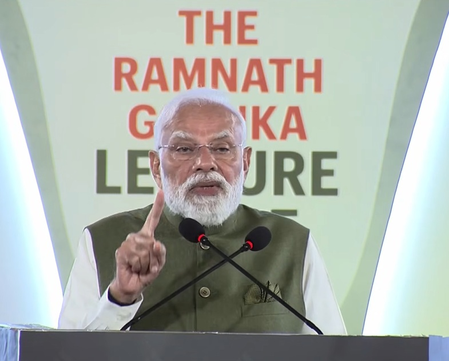
New Delhi, Nov 17 — Prime Minister Narendra Modi, addressing the Ramnath Goenka Lecture at the Excellence in Journalism Awards, called for a nationwide mission to free India from the “slave mentality” imposed by British colonialist Thomas Babington Macaulay nearly two centuries ago.
In a pointed critique, PM Modi linked the Congress party to Maoists and Urban Naxals, whom he claimed were responsible for undermining India’s ancient education system. “Almost every major state was once in the grip of Maoist terrorists. Who nurtured them? Congress gave birth to Maoists and Urban Naxals who openly rejected Bharat’s Constitution,” he said. He further remarked that “the Maoists of the Muslim League have now become Congress municipal councillors,” a statement that drew gasps and applause alike.
Honouring Ramnath Goenka, Modi highlighted the Indian Express founder’s defiance against British censorship, recalling his declaration: “I would rather shut down my newspaper than bow to British ideals.” The Prime Minister said that same fearless spirit is needed today.
Central to his speech was Macaulay’s 1835 Minute on Education, which Modi said aimed to create “a class Indian in blood and colour, but British in taste, opinions, morals and intellect,” uprooting India’s gurukul system. Modi criticized post-Independence governments for continuing to prioritize foreign models over indigenous knowledge and languages.
“We are not against English; we are against the deliberate neglect of Indian languages. In which country are its own mother tongues treated like orphans?” he asked.
Modi announced a national mission: by 2035—200 years after Macaulay’s Minute—India will be free from the mentality of slavery. Over the next decade, he said, the country will rebuild pride in its heritage, languages, and knowledge systems.
Closing his address, Modi tied Goenka’s journalism to India’s ongoing transformation: “Ramnath ji fought colonial slavery with his pen. Today, we fight mental slavery with education, innovation and unbreakable self-confidence. The most glorious chapters are yet to be written.”