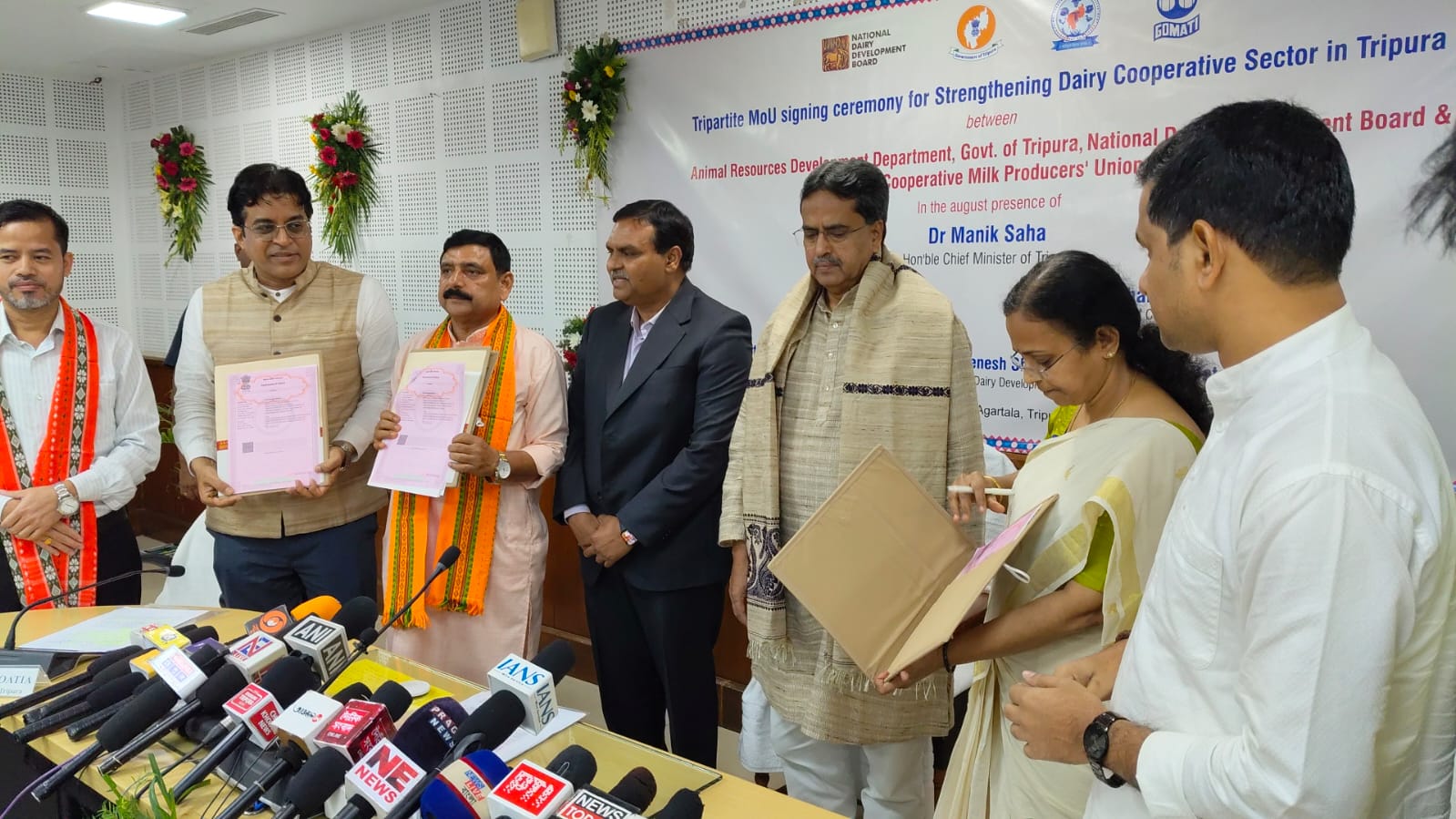
Agartala, June 24: In a major step towards transforming Tripura’s dairy industry, a tripartite Memorandum of Understanding (MoU) was signed on Tuesday between the Animal Resources Development Department (ARDD), the National Dairy Development Board (NDDB), and the Gomati Cooperative Milk Producers’ Union Limited (GCMPUL). The agreement aims to strengthen cooperative dairy development in the state and advance the objectives of White Revolution 2.0.
The MoU was signed at the New Secretariat in Agartala in the presence of Chief Minister Dr. Manik Saha and NDDB Chairman Dr. Meenesh Shah, along with senior government officials and representatives of the dairy cooperative sector.
Addressing the gathering, Chief Minister Dr. Saha emphasized that Tripura must actively participate in the country’s dairy-led growth movement and capitalize on its existing strengths in livestock development.
“White Revolution should happen in Tripura as well. If other states can achieve it, there is no reason why Tripura cannot,” he said, calling for coordinated efforts from government departments, dairy cooperatives, and farmers.
The agreement seeks to facilitate the preparation and implementation of a Comprehensive Cooperative Dairy Development Plan (CCDDP) aligned with the national vision of White Revolution 2.0. The initiative aims to strengthen dairy cooperatives, enhance milk production and productivity, modernize infrastructure, promote digitalization, and create sustainable livelihood opportunities for dairy farmers.
Dr. Saha highlighted the progress achieved in the livestock sector through artificial insemination, scientific breeding, and cattle induction programmes. He noted that milk production in Tripura has been growing at an annual rate of nearly 6.5 percent, with the state currently producing around 2.63 lakh metric tonnes of milk annually, equivalent to nearly 7.2 lakh litres per day.
The Chief Minister further stated that Tripura’s per capita milk availability has reached 173 grams per person per day, the highest among Northeastern states. However, he pointed out that only a limited share of milk production enters the organized dairy processing network.
He stressed the need to increase milk procurement to fully utilize the state’s dairy processing plant, which has a capacity of 40,000 litres per day. Enhanced procurement, he said, would support the production of value-added dairy products such as paneer, curd, ghee, lassi, ice cream, and sweets, thereby boosting farmers’ incomes.
NDDB Chairman Dr. Meenesh Shah presented a roadmap for strengthening dairy cooperatives, improving productivity, expanding infrastructure, and enhancing market access. Under the MoU, the state government will provide policy support, GCMPUL will serve as the implementing agency, and NDDB will offer technical expertise, capacity building, infrastructure planning, and market development assistance.