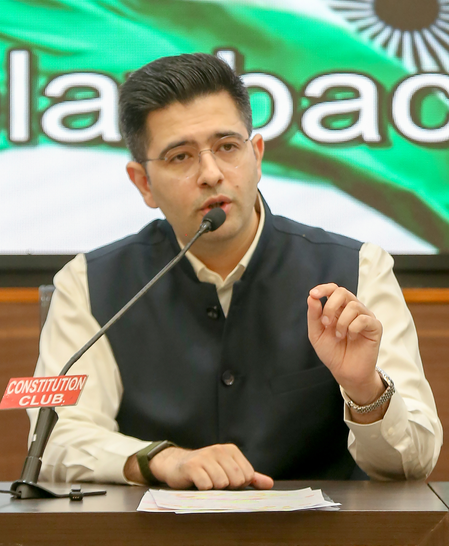
The Aam Aadmi Party (AAP) suffered a major political setback on Friday as several of its prominent leaders and sitting Rajya Sabha MPs, led by Raghav Chadha, formally announced their departure from the party to join the Bharatiya Janata Party (BJP). The move marks one of the biggest internal ruptures in AAP’s history and significantly alters its strength in the Upper House.
The development was announced at a high-profile press conference where Chadha, accompanied by MPs Ashok Mittal and Sandeep Pathak, sharply criticised the party’s trajectory since its inception in 2013. Declaring a collective decision, Chadha said that nearly two-thirds of AAP’s Rajya Sabha members had chosen to merge with the BJP, invoking provisions under the Tenth Schedule of the Constitution to avoid disqualification under anti-defection laws.
According to Chadha, more than seven of AAP’s 10 Rajya Sabha MPs are part of the shift. The move was later formalised at the BJP headquarters in New Delhi, where party leaders welcomed the defectors.
Once considered a key aide to Arvind Kejriwal and a leading strategist, Chadha’s exit is being viewed as a significant blow to AAP’s leadership structure. Pathak, another strategist credited with the party’s Punjab success, and Mittal, founder of Lovely Professional University, also played important roles within the party.
The exodus comes at a critical time for AAP, which is preparing for the 2027 Punjab Assembly elections. The party now faces a steep decline in its Rajya Sabha representation, with only three MPs remaining, weakening its legislative influence.
Explaining their decision, the departing leaders accused AAP of deviating from its founding ideals, alleging that it had become “corrupt” and “self-serving.” They described their move to the BJP as a step towards “positive politics.”
The BJP welcomed the development, calling it a sign of disillusionment with AAP’s governance model. Meanwhile, AAP strongly condemned the defections, branding the leaders as “traitors” and accusing the BJP of orchestrating the move.
With its national footprint shrinking and internal stability under strain, the party now faces a critical phase as it attempts to regroup ahead of key electoral battles.