Agartala, September 9:
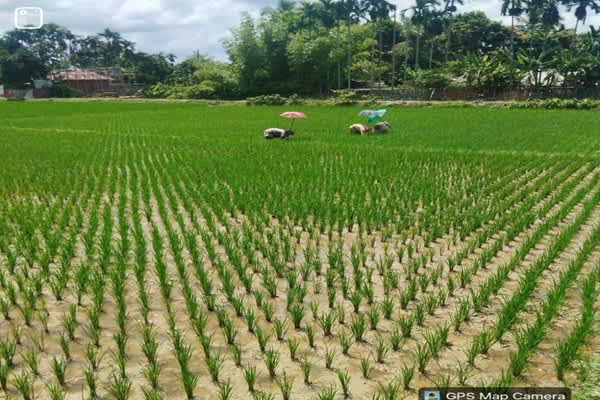
The monsoon has brought renewed optimism to the farming communities of Kalyanpur Agricultural Sub-Division, where Aman paddy has developed well across large stretches of farmland and cultivators are now looking forward to the harvesting season.
From Ghilatli and Madhya Kalyanpur to Dwarikapur, Gopalnagar, Ratia and Shantinagar, farmers are spending long hours in the fields to protect and nurture their crops. The green paddy plants, strengthened by regular rainfall, have raised hopes of a satisfactory yield.
Farmers say the weather conditions so far have been largely favourable for cultivation. Adequate rainfall has helped maintain moisture in the fields and supported healthy crop development. However, cultivators remain aware that the situation can change quickly during the remaining growing period.
Excessive rainfall, prolonged dry spells, strong winds and pest attacks continue to pose potential risks. Farmers are therefore keeping a close watch on their fields, carrying out weeding, applying fertilisers and taking preventive measures against insects and crop diseases.
Mahendra Debnath and Rajib Pal, farmers from Ghilatli, said their paddy fields are currently in good condition. They attributed the healthy growth to favourable weather and expressed hope that the crop would yield enough grain for household consumption while leaving a surplus that could be sold in local markets.
For farming families, Aman cultivation remains closely linked to their financial well-being. A successful harvest can provide food for the household and generate income at a time when the cost of agricultural operations has increased.
Yet, farmers say a good crop alone does not guarantee economic security. They are seeking closer assistance from agricultural officials, particularly during the critical stages of crop growth.
Regular field inspections, timely technical advice and quick action during pest and disease outbreaks, they said, could prevent avoidable crop losses. Farmers have also emphasised the need for reliable access to fertilisers, quality seeds, pesticides and other essential agricultural inputs.
Market prices remain another important concern. According to cultivators, increasing expenses on labour, fertilisers, pesticides, irrigation and other inputs have raised the overall cost of production. If paddy prices remain low after harvest, farmers fear that much of the benefit from higher production could be lost.
They have urged the administration and agriculture authorities to strengthen market support and ensure that farmers receive a fair price for their produce. Preventing distress sales, they said, is essential for making cultivation financially sustainable.
Despite these concerns, the mood in Kalyanpur’s farming villages remains cautiously optimistic. The current condition of the fields has given cultivators reason to expect a better season, although they know the crop will remain vulnerable until it is harvested and stored safely.
The transformation of the green paddy fields into golden stretches over the coming weeks will be closely watched by farming families. For them, the Aman harvest represents not simply agricultural output but food security, household income and the possibility of easing financial pressures.
As farmers continue their daily work, their immediate hope is for stable weather until harvest time—enough sunshine for the grain to mature, sufficient rainfall to sustain the crop and protection from storms, pests and other threats.
The coming weeks will ultimately determine whether Kalyanpur’s promising green fields translate into the abundant harvest that farmers are hoping for.